



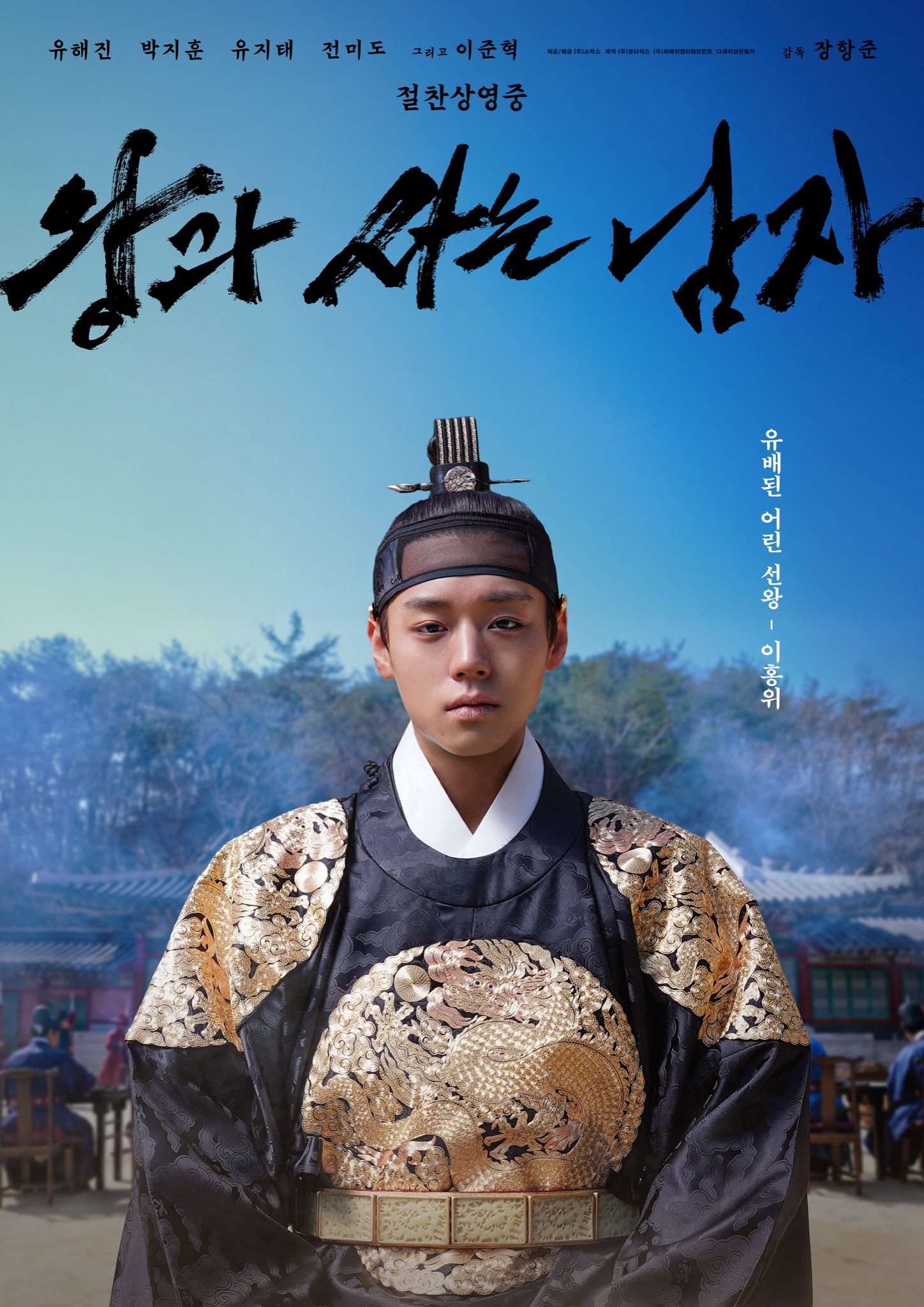

Jang Hang-jun’s historical drama takes one remembered act of courage and imagines the relationship that could have made it possible.
A king loses his throne, his title and finally his life. A local man then does something that the winning side wants no one to do: he gives the dead king a grave.
That act is the historical anchor of 왕과 사는 남자, listed in the Korean Film Council database as The King’s Warden and introduced in some official English material as The Man Who Lives With the King. The film does not attempt to reconstruct every day of King Danjong’s exile. It asks a more intimate question. Why would Eom Heung-do risk himself and his family to bury a deposed ruler whom power had ordered the world to forget?
Director Jang Hang-jun’s answer is openly dramatic rather than archival: perhaps the two men came to know one another during Danjong’s final months in Yeongwol. The result is a historical film built around the space between a documented action and an undocumented relationship.
| At a glance | Details |
|---|---|
| Korean title | 왕과 사는 남자 |
| English titles in official sources | The King’s Warden; The Man Who Lives With the King |
| Korean release | February 4, 2026 |
| Running time / genre | 116 minutes; historical drama |
| Director and screenwriter | Jang Hang-jun |
| Central cast | Yoo Hae-jin, Park Ji-hoon, Yoo Ji-tae |
| Historical center | Danjong’s 1457 exile and death; Eom Heung-do’s burial of the king |
| Key place | Yeongwol, Gangwon State |
Showbox’s official trailer introduces the relationship the film imagines between Danjong and Eom Heung-do.
The boy king caught inside a succession crisis
Danjong was born Yi Hong-wi in 1441. His grandfather was King Sejong, remembered for the creation of Hunminjeongeum, the writing system that became Hangul. His father, King Munjong, ruled for only a short period. When Munjong died in 1452, Danjong inherited the throne while still a child.
That youth made the throne vulnerable. Grand Prince Suyang, one of Sejong’s sons and Danjong’s uncle, removed powerful court officials in the 1453 coup known as the Gyeyu Jeongnan. In 1455, Danjong was forced to yield the throne. Suyang became King Sejo.
The transfer did not end the political danger. Efforts to restore Danjong gave opponents of Sejo a living symbol around whom they could organize. Danjong was demoted further and sent to Yeongwol in 1457. Later that year, after another restoration attempt associated with Prince Geumseong, the former king died at sixteen.
Accounts and later representations differ over the precise manner of his death. The film chooses a dramatic rendering; Korean historical and tourism sources discuss an order involving poison and the political likelihood that Danjong was killed. The stable historical point is not a single cinematic death scene. It is that the deposed king died under coercive royal power, and that honoring his body carried political risk.
His name was not fully restored immediately. In 1698, more than two centuries later, King Sukjong reinstated him as a king. That restoration transformed a suppressed prince into a moral figure of loyalty and wrongful displacement. Yeongwol’s memorial landscape grew around that memory.
| Date | Historical change | Why it matters to the film |
|---|---|---|
| 1452 | Yi Hong-wi becomes King Danjong | A child inherits a court already shaped by powerful adult factions |
| 1453 | Grand Prince Suyang seizes power in the Gyeyu Jeongnan | The uncle becomes the political center before taking the throne |
| 1455 | Danjong yields the throne; Suyang becomes King Sejo | The king is alive but stripped of effective sovereignty |
| 1457 | Danjong is exiled to Yeongwol and dies there | The film concentrates on these final months away from court |
| 1698 | Danjong’s royal title is restored | Private loyalty becomes part of official royal memory |
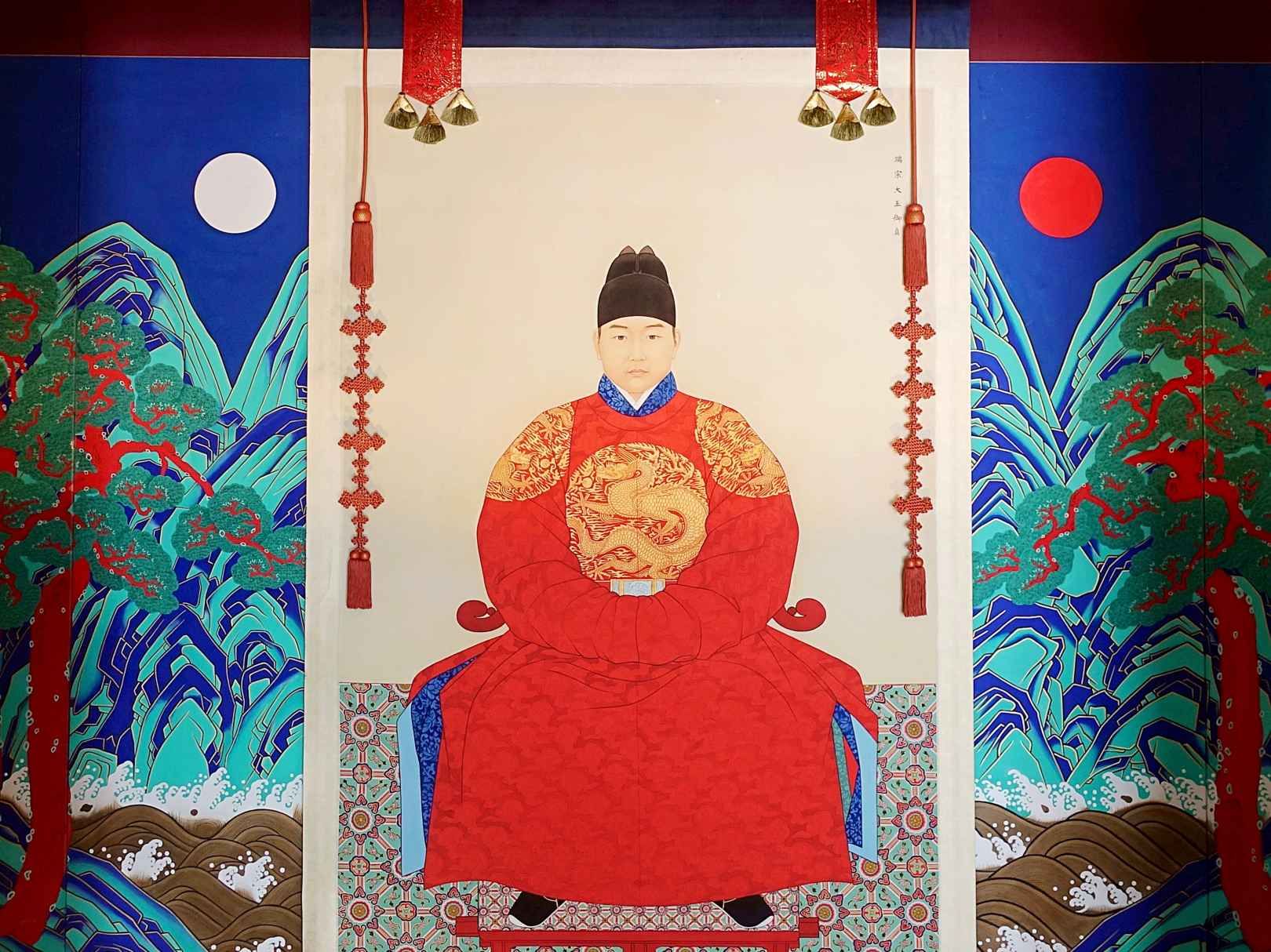
A portrait of King Danjong accompanies VISITKOREA’s official history-and-film route through Yeongwol. Image: Korea Tourism Organization / VISITKOREA.
What history records—and what the film imagines
Eom Heung-do is not a fictional device. Korean historical memory preserves him as the man who recovered Danjong’s body and buried it when doing so could invite punishment. Later entries in the Annals of the Joseon Dynasty praise that choice; Jangneung in Yeongwol includes a pavilion commemorating him.
The archive does not provide the film with a complete friendship. That is the creative opening Jang Hang-jun uses.
In the film, Yoo Hae-jin’s Eom is a pragmatic village chief, not a saint waiting for martyrdom. He hopes that receiving an exiled nobleman might eventually benefit the village. Instead, the exile sent to him is Yi Hong-wi, the deposed king—politically dangerous, emotionally closed and treated by the state as almost already dead.
Meals, labor and village life gradually create a relationship. This is the film’s invention, and it should be understood as such. But invention is not the same as indifference to history. The imagined bond is a hypothesis built to explain an action: if Eom later risked everything for Danjong’s body, what might he have come to see in the young man while he was alive?
The distinction makes the film more interesting, not less.
| Historical anchor | The film’s imaginative bridge |
|---|---|
| Danjong was deposed, exiled to Yeongwol and died in 1457 | The exile contains warmth, humor and shared daily life rather than unbroken ceremonial tragedy |
| Eom Heung-do is remembered for recovering and burying the body | Eom and Danjong develop a personal bond capable of explaining that risk |
| Han Myeong-hoe was a central power figure in Sejo’s political order | He becomes a charismatic strategist rather than a flat emblem of treachery |
| Yeongwol physically separated Danjong from the capital | The landscape becomes a temporary community where he can be treated as a person again |
The film is therefore less a hidden-history exposé than a moral thought experiment. It knows the burial happened. It builds a human story sturdy enough to carry the weight of that fact.
The actors: dignity, ordinariness and political intelligence
The three central performances operate on different levels of power.
Yoo Hae-jin as Eom Heung-do
Yoo Hae-jin began in theater and became one of Korean cinema’s most dependable character actors, moving from sharply comic supporting roles to major dramatic leads. International audiences may recognize him from Veteran, A Taxi Driver, 1987: When the Day Comes, Confidential Assignment and Space Sweepers.
His casting keeps Eom grounded. Yoo is especially good at characters who think first about work, food, money and immediate survival, then discover that their ordinary competence has become a moral position. That prevents Eom from entering the film as a monument. The historical tribute arrives only after the audience has met a man with practical motives.
Park Ji-hoon as Yi Hong-wi, King Danjong
Park Ji-hoon entered public life as a singer and developed a distinct acting career, with Weak Hero Class 1 becoming a decisive demonstration of his ability to hold anger and vulnerability in the same frame. Jang has said that performance helped lead him to Park for Danjong.
The role needs more than fragility. A deposed king can be powerless without forgetting that he was trained to rule. Park’s Danjong moves from a boy who has lost the will to live toward someone who can again speak with royal authority. The tension between Yi Hong-wi, the isolated teenager, and Danjong, the remembered king, is the performance’s central task.
Yoo Ji-tae as Han Myeong-hoe
Yoo Ji-tae’s career stretches from the quiet romantic realism of One Fine Spring Day to the controlled menace of Oldboy, alongside his own work as a director. As Han Myeong-hoe, he represents power that has learned to describe itself as necessity.
Rather than reducing Han to “the traitor,” the film treats him as a capable political actor inside Sejo’s new order. That choice gives Danjong a more formidable opposite. The young king is not crushed by a cartoon villain but by an intelligent system with people able to defend what it has done.
The ensemble also includes Jeon Mi-do and Kim Min, while Lee Jun-hyuk makes a special appearance as Prince Geumseong, one of the royal figures associated with efforts to restore Danjong.
Why Jang Hang-jun was an unexpected—but precise—choice
Jang Hang-jun built his film career across tones. He made the comedy Turn On the Lighter, directed the memory-box thriller Forgotten and turned a real high-school basketball story into the sports drama Rebound. The King’s Warden is his first historical feature.
Korean audiences also know a second Jang Hang-jun: the quick, self-deprecating television storyteller. On tvN’s 알쓸범잡 (The Dictionary of Useless Crime Knowledge), he appeared as the “film expert” in conversations about crime and society. He later served as an MC on 알쓸인잡, a series about human beings across literature, science and history, and on the travel-and-knowledge series 알쓸별잡.
Those programs are not incidental celebrity credits. They reveal the method that suits this film. Jang often enters a difficult subject through an accessible anecdote, lets experts and evidence complicate it, then returns to the human question that made the story worth telling. The King’s Warden performs a similar movement. It begins with a stark historical fact, refuses to leave the figures as textbook names and uses humor to make the coming loss more—not less—painful.
His public persona also changes expectations. A director associated with wit can find comedy in village life without turning Danjong’s fate into a joke. The laughter establishes what the king might have recovered in Yeongwol: not political power, but ordinary membership in a community.
Showbox’s official launch trailer foregrounds the villagers, the exiled king and the emotional movement from transaction to loyalty.
Director route: KOFIC profile and filmography · tvN 알쓸범잡 · tvN 알쓸인잡 · tvN 알쓸별잡
Kim Eun-hee: the other famous storyteller in the family
Jang Hang-jun is married to screenwriter Kim Eun-hee, one of the defining writers of modern Korean genre television. Her credits include the forensic drama Sign, the cyber-investigation series Ghost, the time-crossing crime drama Signal and Netflix’s Joseon zombie thriller Kingdom. She later wrote the occult mystery Revenant.
It is tempting to turn two well-known writers in one household into a single creative brand. Their careers are more interesting when kept distinct. Kim is known for constructing large systems—institutions, epidemics, crimes and histories—that pressure her characters. Jang’s directing persona often begins with the odd, vulnerable person caught inside such a system. They share a public enthusiasm for story, but The King’s Warden is Jang’s film, not an unofficial Kim Eun-hee project.
Her relevance here is still real. Kingdom helped demonstrate how Joseon history could support globally legible genre storytelling without becoming generic medieval decoration. The King’s Warden takes a quieter path, yet it works in the same broad cultural space: the past is not a costume cabinet. It is a structure of power whose consequences can be made emotionally immediate.
Netflix’s official introduction to Kim Eun-hee and Kingdom
Yeongwol: three places that turn the story into a landscape
The film’s most important “motif” is not a single prop. It is Yeongwol itself. The geography explains exile, the buildings preserve the final days and the tomb shows how dangerous private memory eventually became public honor.
1. Cheongnyeongpo: isolation made visible
Cheongnyeongpo is surrounded by water on three sides and blocked by steep terrain on the other. Visitors cross by boat. The result is often described as an island on land—beautiful, contained and difficult to escape.
For the film, this is more than an accurate location. It externalizes Danjong’s political condition. He is inside Joseon but removed from its public life; visible enough to monitor, remote enough to erase. The pine forest and river make isolation readable before a character explains it.
2. Gwanpungheon: the last residence
After flooding at Cheongnyeongpo, Danjong was moved to Gwanpungheon, a government guesthouse in central Yeongwol. He spent his final days there. The current structure is reconstructed, yet the site marks an important shift from geographical imprisonment to the final administrative space of his life.
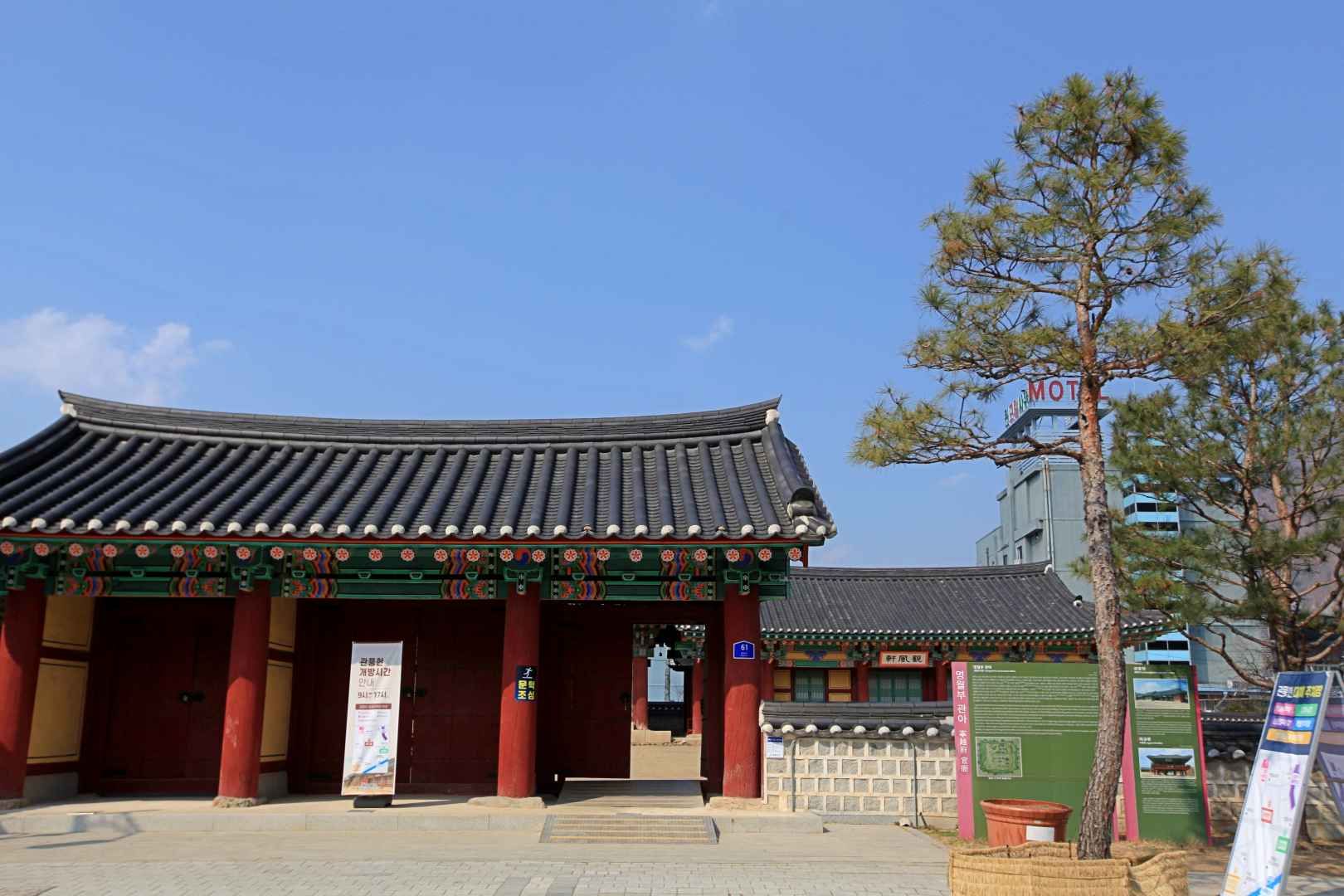
Gwanpungheon preserves the location associated with Danjong’s final days after the flood at Cheongnyeongpo. Image: Korea Tourism Organization / VISITKOREA.
3. Jangneung: a grave becomes a public argument
Jangneung is Danjong’s royal tomb and part of the UNESCO-listed Royal Tombs of the Joseon Dynasty. Within the grounds, visitors encounter not only the king’s burial mound but memorials to the people who remained loyal to him, including a pavilion for Eom Heung-do.
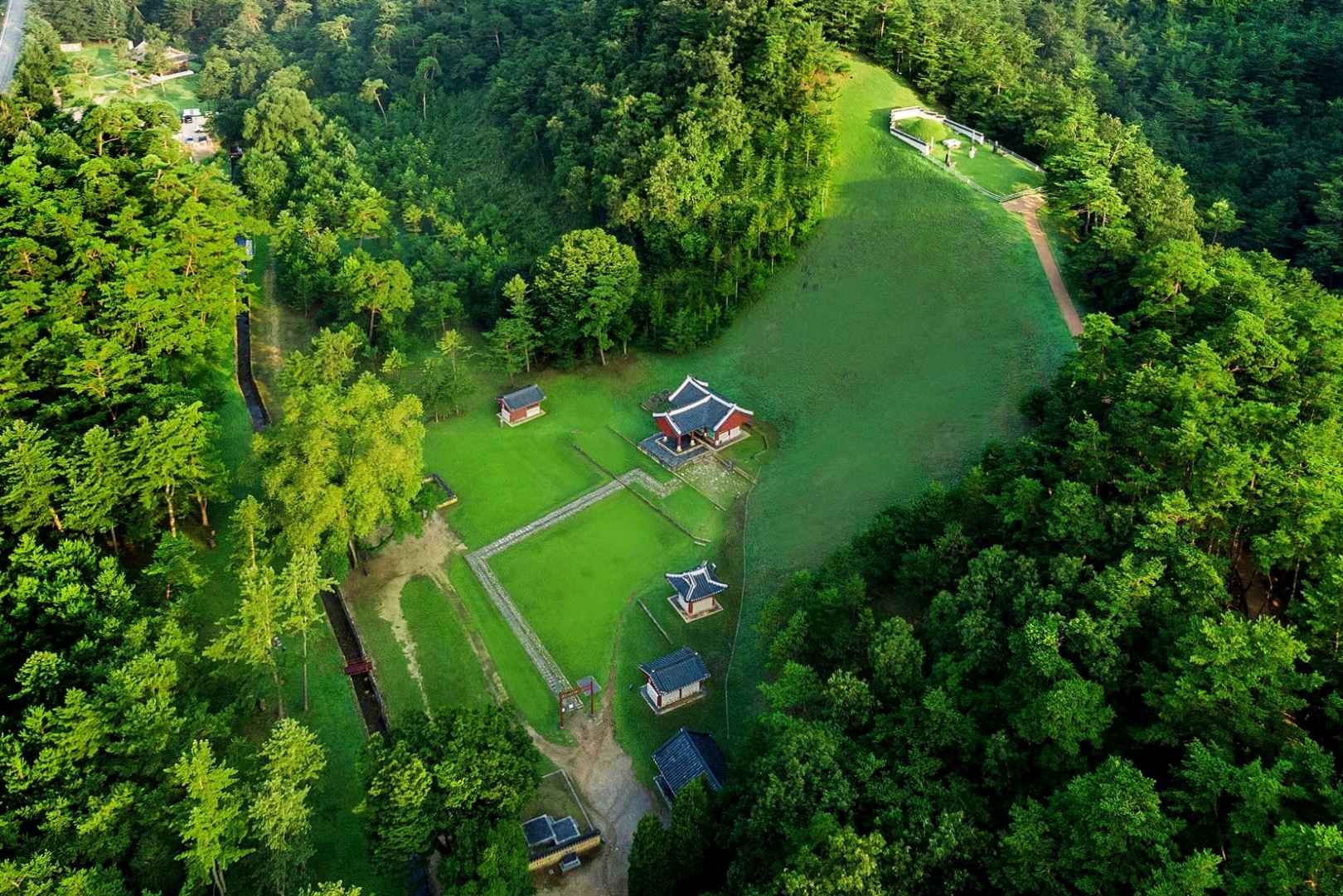
Jangneung turns the film’s private act of burial into a public landscape of memory. Image: Korea Tourism Organization / Royal Palaces and Tombs Center via VISITKOREA.
That makes Jangneung the film’s moral endpoint. Eom’s act begins as disobedient burial; later generations turn it into exemplary loyalty. The site records not only who ruled, but who refused to let defeat decide whose body deserved care.
| Place | Meaning in the story | Visitor information checked April 2026 |
|---|---|---|
| Cheongnyeongpo | Exile, separation and the temporary village relationship imagined by the film | 133 Cheongnyeongpo-ro; adults KRW 3,000; about 1–1.5 hours; closed Mondays |
| Gwanpungheon | Danjong’s final residence after flooding | 61 Jungang-ro; free; about 15–30 minutes |
| Jangneung | Burial, Eom’s remembered action and Danjong’s eventual restoration | 190 Danjong-ro; adults KRW 2,000; about 1–1.5 hours; closed Mondays |
Hours and admission can change. Use VISITKOREA’s Yeongwol film-and-history guide and the linked local pages when planning a visit.
The best way to read the film
Historical films are often judged by a binary question: “Did this happen?” That question is necessary, but it is too small for The King’s Warden.
The more useful sequence is three questions. What does the record anchor? What does the film invent? Why was that invention chosen?
The record anchors Danjong’s fall, exile and death, and the memory of Eom Heung-do’s burial. The film invents a shared daily life. It chooses that invention to make one historical act emotionally intelligible. We may never know the private motive that carried Eom toward the body. The movie asks us to imagine that loyalty can begin before it acquires a grand name—over meals, arguments, work and the recognition of a lonely person.
Yeongwol completes that argument. Cheongnyeongpo shows the isolation. Gwanpungheon holds the final days. Jangneung proves that political erasure did not remain final.
That is why the film begins, in a sense, with one burial. A king’s authority ends. Another man’s responsibility begins.