


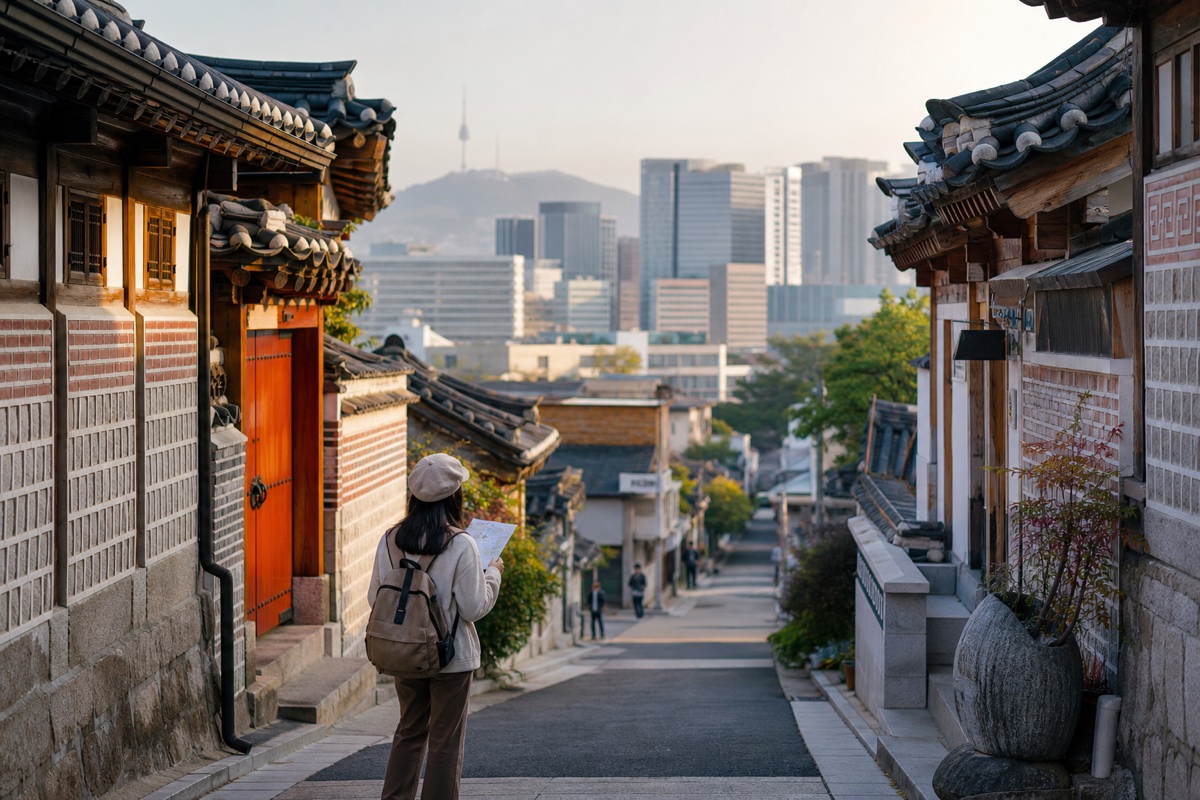

A good filming-location day is not a race to reproduce as many screenshots as possible. It is a small, walkable story: one neighborhood, two or three confirmed locations, time to notice the real place, and a backup plan when access or weather changes.
Choose one geographic cluster
Start with the scene you care about most, then place it on a map. Add only nearby locations that fit the same district or transit corridor. Seoul, Suwon, Jeonju, and Andong all appear in official filming-location itineraries, but combining them in one day usually creates more transit than experience.
For example, the Korea Tourism Organization’s Suwon course groups Suwon Hwaseong, Haenggung-dong, and nearby food streets into a compact route. Its “Our Beloved Summer” guide links Bukchon-area streets in Seoul with Suwon locations, but those are better treated as separate half-day or full-day plans.
Confirm that the location is still visitable
Screen locations change after production. A business may close, a set may be removed, a school may restrict entry, or a residential alley may ask visitors to remain quiet. Check the official tourism page, the venue’s own site, and a current map listing. Look for operating days, reservation requirements, last admission, renovation notices, and photography rules.
Do not enter a private property simply because a scene was filmed there. For schools, homes, offices, restaurants, and places of worship, public access is determined by the property owner—not by the drama’s popularity.
Build a route with realistic time
- Mark the exact entrance or public viewpoint for each stop.
- Estimate walking time using a Korean map service.
- Add at least 20 minutes at the main location and 10 minutes for each transfer.
- Place one meal or café stop near the midpoint, not across the city.
- Choose an indoor alternative in the same area.
Three meaningful stops are usually enough for a half-day. If a location is mainly interesting because of one camera angle, combine it with a museum, market, fortress, park, or local street that explains the area beyond the show.
Save names in Korean
Keep the Korean place name and road address in your notes. Translated titles can vary between streaming platforms, and two businesses may share a similar English name. A saved Korean address makes it easier to compare map results, ask staff, or show the destination to a taxi driver.
Download a screenshot of the scene only for personal reference. Do not republish copyrighted drama stills as your own travel content. For a public post, use your own location photograph or an image with a license that clearly permits publication.
Photograph without disrupting the place
- Stay on public paths and obey barriers and staff instructions.
- Ask before photographing people, shop interiors, or merchandise displays.
- Keep tripods and repeated takes out of narrow residential lanes.
- Do not block a doorway to match a scene.
- Lower your voice near homes, schools, hospitals, and religious sites.
A respectful visit protects the location for residents and future fans. If a sign asks visitors not to film or photograph, put the camera away.
Use the drama as a doorway to local context
A location becomes more memorable when you understand what exists outside the frame. Suwon Hwaseong is a UNESCO World Heritage fortress and an active part of the city. Bukchon is a living hanok neighborhood, not an outdoor set. Sewoon Plaza has its own urban and commercial history beyond its appearance in “Vincenzo.” Read the official destination description and spend something at a local business only when you genuinely want its product or service.
Plan for weather and production changes
Outdoor scenes can look completely different in rain, snow, summer heat, or winter darkness. Check the forecast, sunset time, and walking conditions. A museum, visitor center, market, or café in the same district is a better backup than crossing Seoul for a second outdoor stop.
If the location has changed, document the present honestly. “This building replaced the storefront seen in the series” is useful travel information. Trying to hide changes makes a guide less trustworthy.
A simple filming-location day template
- 09:30: arrive at the main public attraction before peak crowds.
- 11:00: walk to one secondary scene location.
- 12:00: lunch in the same district.
- 13:30: visit an indoor cultural or historical site.
- 15:00: final viewpoint or café, then return before rush hour.
Adjust the sequence to official opening times. The goal is a coherent day that would still be enjoyable even if you had never watched the drama.
Last fact-checked: July 25, 2026. Access and business details can change; verify each location before departure.
